Resource
When Should a Startup Hire Its First Head of Design?

July 27, 2026
July 26, 2026
There is no funding round or headcount number that tells a startup when to hire its first Head of Design.
A Series A team can still be too early. A ten-person company can already be late.
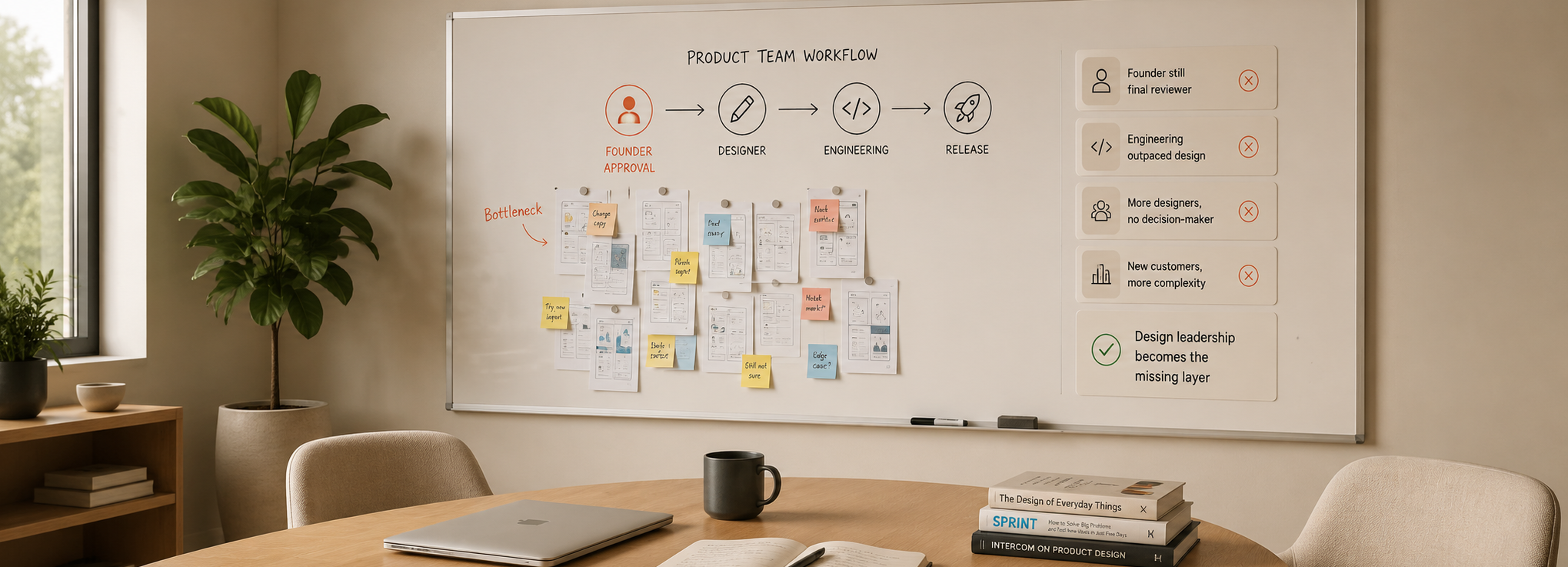
The difference shows up inside the work: the founder remains the final reviewer, designers have no clear escalation point, engineering keeps moving while design falls behind, and new customers introduce complexity the team has never handled before.
Those are the signals worth watching.
This guide looks at when a stronger designer is enough, when the gap has become a leadership problem, and whether that leadership needs to be full-time.
Four signs your startup has outgrown its current design setup
None of these track cleanly to company age or team size.
They show up whenever they show up, and the earlier you notice them, the less damage accumulates before someone addresses the gap.
1. The founder is still the final reviewer
Founder involvement is normal early on. Nobody expects a five-person startup to have a design leader, and the founder often has more product context than anyone else in the building.
The shift happens when every meaningful design decision still needs their sign-off, not as occasional input but as the default checkpoint. Past a certain size, that's not diligence.
It means no one else in the company has the standing to make the call, and every decision routes through one already-overloaded person by default.
2. Engineering has outpaced design
One designer can support a handful of engineers when the product is small and the roadmap is manageable.
The strain shows up as engineering keeps shipping and design capacity stays flat.
Research gets shortened because there isn't time to do it properly. Edge cases get resolved mid-build instead of upfront.
Existing patterns get reused in places they don't quite fit, because building something new would take longer than the sprint allows.
Teams usually describe this as a delivery problem first, engineers waiting on designs, releases slipping, before anyone connects it back to design capacity.
3. More designers, still no decision-maker
Hiring a second or third designer adds capacity. It doesn't automatically add resolution.
Once several people are designing across different parts of the same product, they disagree, on patterns, on scope, on how one part of the experience should relate to another.
Disagreement itself is healthy. The problem is what happens next when there's no clear owner: the most confident voice wins, or the decision escalates to the founder by default, or two designers ship two different answers to the same underlying question.
Adding headcount without adding leadership can leave a product less coherent than it was with a single designer making every call.
4. New customers are exposing complexity fast
This one usually arrives suddenly.
A company moving upmarket into enterprise accounts runs into requirements a simple SaaS product was never built for: permissions, admin roles, audit logs, approval chains, multiple teams operating inside one account.
None of that exists in a single-user product, and none of it gets handled well by a team encountering it for the first time under deal pressure.
Handled request by request, each fix solves one customer's immediate ask while making the product's overall structure harder to reason about.
Someone needs a view across the whole experience, not just the ticket in front of them.
Why funding is a poor signal for hiring design leadership
A round changes what you can afford.
It doesn't change how design decisions get made the day after it closes.
A Series A team can still have one designer, a founder in every review, and no enterprise complexity yet, meaning they're not at the hiring point.
A seed-stage team with two designers and an enterprise pilot already underway can be past it.
Round size and readiness aren't the same axis.
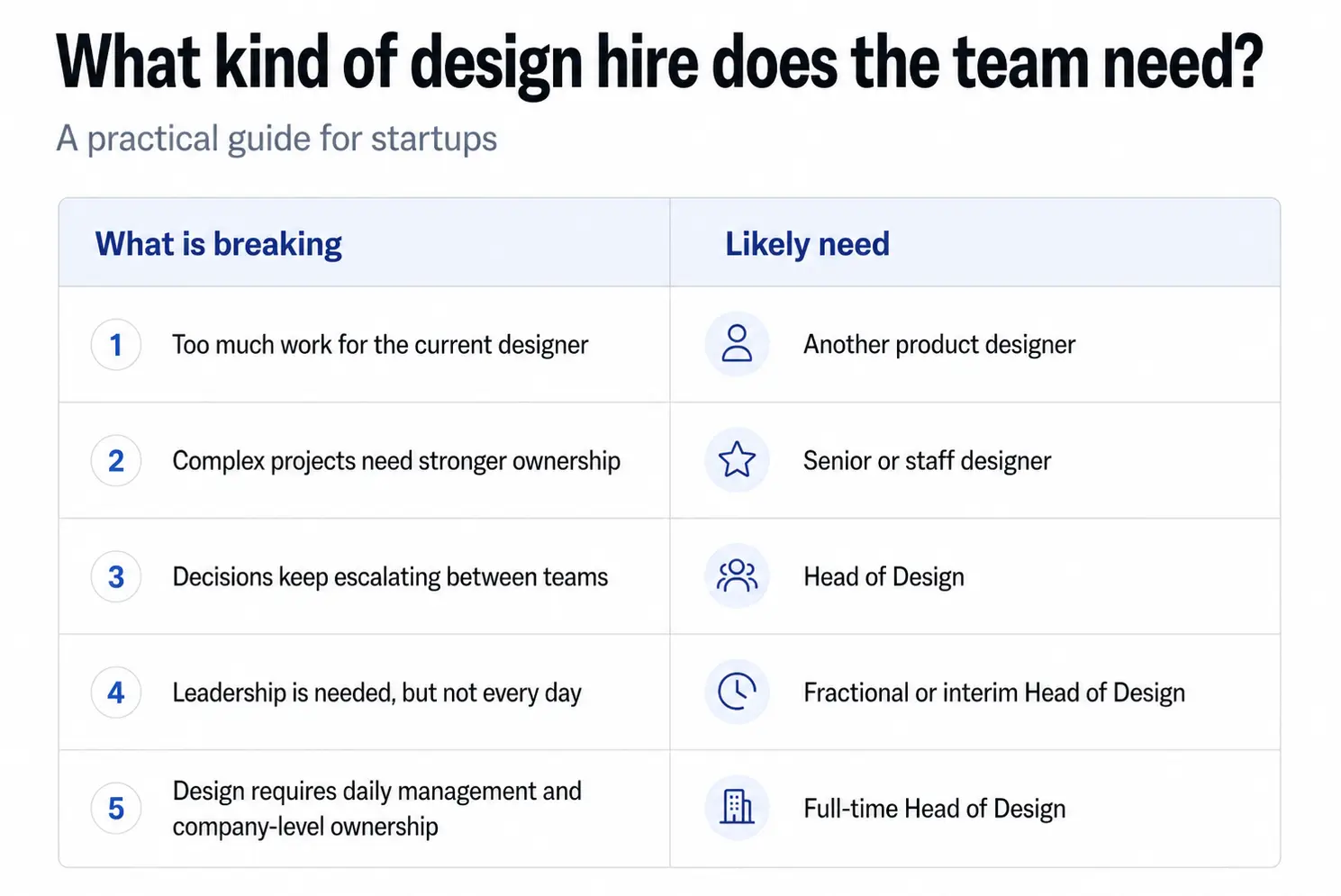
A stronger designer, or a design leader
A senior designer, however good, owns one project or product area.
What they can't do, because it isn't their role: arbitrate between two designers who disagree, say no to a founder's feature request, or set a direction others follow without checking back.
A Head of Design does exactly those three things: makes the cross-team call when people land on different answers, develops how other designers think rather than just reviewing their files, and has the standing to tell a founder a feature shouldn't ship yet, and make it stick.
If the gap is execution quality, hire a stronger IC.
If it's who has the authority to decide, that's a leadership gap. Skill alone doesn't fix it.
Design leadership does not have to start as a full-time role
Once founders see the gap, it usually becomes "hire full-time now" or "wait." That's a false choice.
A full-time hire is a real commitment: senior salary, slow search, a bet that the need is stable enough for a permanent seat.
Teams that just crossed these signals often haven't reached that bet yet.
Fractional or interim design leadership covers the same ground, cross-team decisions, mentoring, founder pushback, sized to where the company actually is, without locking in a full-time seat before the shape of the need is clear.
Size the decision, not the calendar
Three questions, answered honestly, tell you more than any funding milestone will.
1. Are you still the last reviewer on every screen that ships?
If yes, no one else in the company currently has the standing to make that call.
2. Has engineering outpaced design for two or more quarters, with no one owning the tradeoffs between designers if you have more than one?
If yes, the gap is structural, not a hiring-a-better-IC problem.
3. Is a new customer segment, usually enterprise, exposing product complexity your current team hasn't handled before?
If yes, someone needs to be making senior design calls under that pressure now, not once the next round closes.
Two or more yes answers means the gap is real.
What's still open is sizing it: full-time seat, or fractional leadership while the shape of the need becomes clearer.
Frequently Asked Questions
How early is too early to hire a Head of Design?
It is probably too early if one experienced designer can still cover the product, decisions rarely escalate, and the founder’s involvement is selective rather than constant.
Hiring the title before the responsibility exists often creates an expensive role with too little real leadership work.
Can an existing senior designer step into the role?
Sometimes. The deciding factor is whether the company is prepared to give them authority, not just a new title.
They need to be able to set direction across teams, resolve disagreements, shape hiring, and challenge senior product decisions without routing everything back through the founder.
What should a Head of Design own in the first 90 days?
The early work should focus on how decisions move through the team.
That usually means clarifying ownership, reviewing the product across key flows, identifying where design debt is slowing delivery, and setting a review process that does not depend on the founder approving every screen.
What happens when a startup hires too late?
The cost usually appears as inconsistency rather than one obvious failure.
Teams reuse patterns badly, enterprise requests get solved in isolation, designers work in different directions, and product decisions become harder to reverse once they are already built.
How do you know whether fractional leadership is enough?
Fractional support can work when the company needs clearer direction, regular senior review, and help developing a small team.
It becomes less suitable when design requires daily executive involvement, frequent hiring, deep cross-functional management, or full ownership of a growing department.